Understanding earthquake physics
Earthquakes are one of the most significant hazards for human society, and, at the same time, remain the most elusive. Improving the ability to forecast earthquakes is one of the main challenges remaining for the natural sciences. With the European Research Council (ERC) Synergy project “Fault Activation and Earthquake Rupture” (FEAR), a consortium of scientists from the Eidgenössiche Technische Hochschule Zürich (ETH Zurich) in Switzerland, the Rheinisch-Westfälische Hochschule (RWTH Aachen University) in Germany, and the Instituto Nazionale di Geofisica e Vulcanologia (INGV) in Italy are conducting a suite of ambitious experiments in the world-unique Bedretto Underground Laboratory for Geosciences and Geoenergy (BedrettoLab), an underground experimental facility in the Bedretto Tunnel, located at 1000m depth under the Swiss Alps.
The core idea of FEAR is to gain understanding on how earthquakes start and stop by using hydraulic stimulation to modify stress and initiate small non-damaging earthquakes (magnitude ~1.0 events on fault patches of 10-50m scale) on candidate faults in the vicinity of the Bedretto Tunnel. A dense network of multidisciplinary sensors will capture the rupture preparation phase, the earthquake rupture, and the post-rupture response of the rock mass. These experiments will give unprecedented up-close near-field insight into the physics of earthquake processes, contribute to pushing forward the current limits on earthquake predictability and advance the state-of-the-art in safe use of geoenergy.
Upcoming FEAR-3 experiment at the BedrettoLab
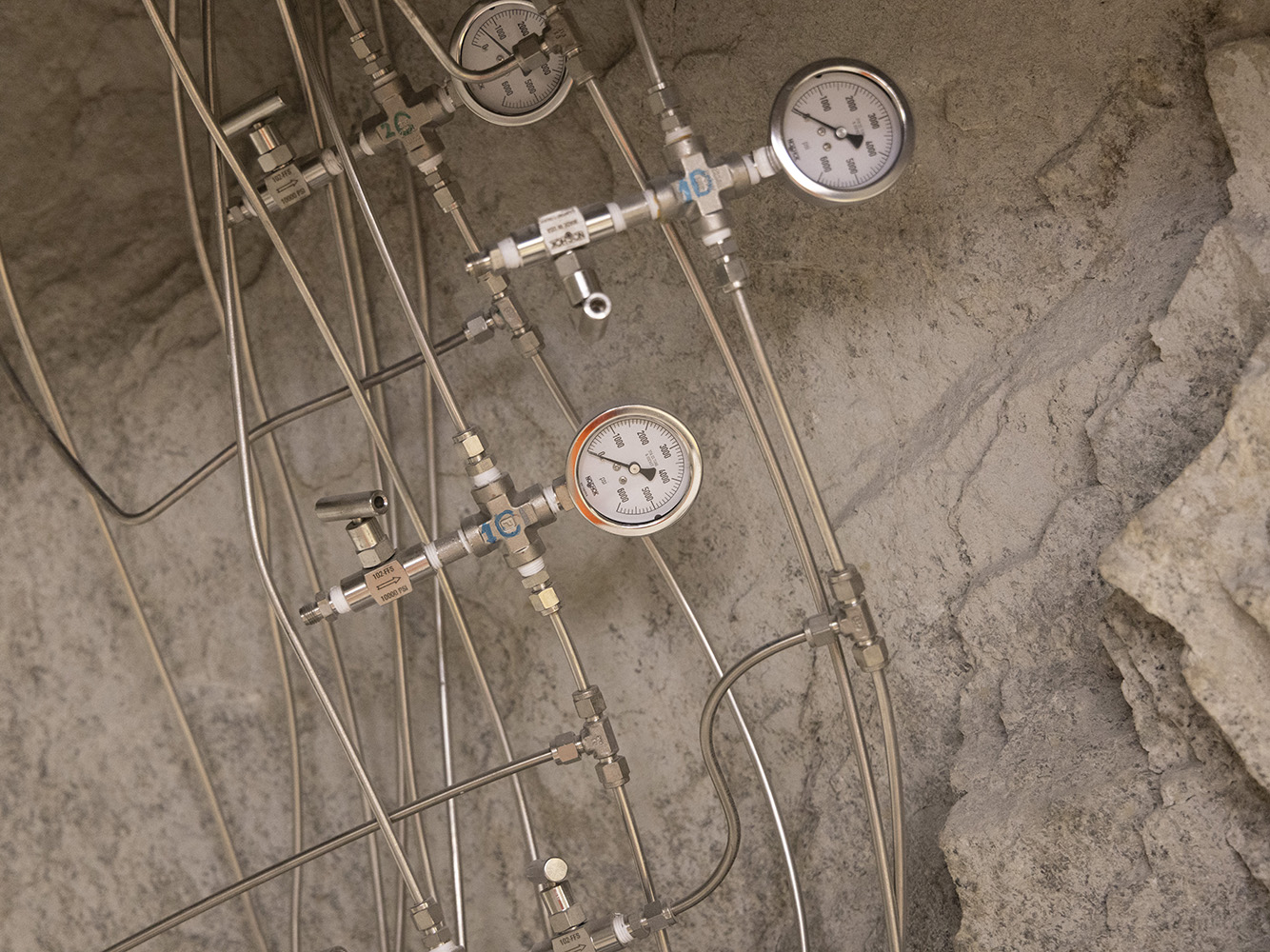
The BedrettoLab is preparing the next phase of the Fault Activation and Earthquake Rupture (FEAR) project. Building on the results of the FEAR-2 experiment conducted in April 2026 (s. previous article), researchers will carry out a new field experiment starting on September 21.
The FEAR project aims to improve our understanding of how earthquakes initiate and propagate by studying fault behaviour under carefully controlled conditions. One of the project's key scientific objectives is to trigger a controlled earthquake of approximately magnitude 1 within a natural fault zone located deep underground and directly accessible for experimentation and monitoring through BedrettoLab’s research infrastructure.
The previous FEAR-2 experiment provided valuable insights into the behaviour of the fault and confirmed the performance of the experimental infrastructure and monitoring systems. The upcoming experiment will build on these findings and further investigate the conditions under which controlled fault slip and earthquake rupture occur.
During the experiment, water will be injected into the fault zone through two boreholes. The injection is expected to last approximately 3 to 5 days. This time, however, we plan to reach high pressures quite rapidly, as fast as technically possible. The experiment will be monitored continuously in real time from the BedrettoLab control centre at ETH Zürich.
A dense monitoring network consisting of sensors installed in and around the fault, including instruments measuring seismic activity, rock deformation, fluid pressure, temperature, and geochemical changes, will record the fault response throughout the experiment. These observations will help researchers better understand the physical processes that govern earthquake nucleation and fault activation.
The experiment has undergone a detailed safety and risk assessment, and multiple layers of safety measures are in place. All injection activities are remotely supervised, and no personnel are present in the BedrettoLab during the main injection phase.
Based on the safety and risk assessment, the seismic risk associated with the experiment is considered very low. Earthquakes generated during the experiment are not expected to be felt at the surface, in nearby buildings, or in the Furka Base Tunnel. The experiment will be conducted under strict operational limits and continuously monitored. If predefined safety thresholds are exceeded, injection operations will be stopped immediately.
Further updates and results will be published following completion of the experiment.
First learnings from FEAR-2
It has now been about three months since the FEAR‑2 experiment. We are currently carrying out an in‑depth analysis of the large data sets collected. What have we learned so far, and what comes next?
This experiment was our first attempt to induce a magnitude 1.0 earthquake in the Earthquake Physics Testbed at BedrettoLab. A magnitude 1.0 event is very small and cannot be felt, but it is an important scientific target. By observing earthquakes of this size under controlled conditions, we can better understand how earthquakes start, grow and stop. Using controlled high‑pressure fluid injections, we were able to activate a specific fault zone and set the surrounding rock in motion.
We recorded more than 12,000 very small earthquakes (“microquakes”) within the experimental area. These events had magnitudes between −5 and −0.1, meaning the target magnitude of 1.0 was not yet reached. The injections were stopped because the activity began to move away from the most densely monitored zone. Despite this, the experiment produced an exceptionally rich dataset that helps us better understand how faults are activated.
A key part of the experiment is our advanced monitoring system. It allows us to measure seismic waves across a wide range of frequencies and amplitudes, as well as other important physical parameters. One important component is a network of fibre‑optic cables installed in boreholes and along the tunnel floor. Using a technique called Distributed Acoustic Sensing (DAS), these cables can detect both ground shaking and very small permanent deformations caused by earthquakes. Such deformations are well known in large natural earthquakes but are rarely measurable in small events.
In addition, a specially designed digital control system allowed us to run and monitor the entire experiment remotely from Zurich. This system is a key part of our safety concept and performed reliably throughout the experiment. For example, during an unexpected electrical short circuit, the system immediately shut down the experiment as designed, preventing further damage and demonstrating the effectiveness of the safety concept.
Although the detailed analysis is still ongoing, the potential of our monitoring system is already clear. For example, the recorded data (see animation) provides a detailed view of how and where the fault was activated.
Based on these results, we are now preparing a series of follow‑up experiments. The goal is to gradually increase the maximum magnitude towards 1.0. These experiments will allow us to observe earthquake processes with unprecedented detail and represent an important step towards controlled earthquake experiments beyond BedrettoLab.
Find out more about our experiments here
FEAR annual meeting 2026 in Airolo
The annual FEAR meeting will take place from 19 to 21 May 2026 in Airolo.
FEAR annual meeting 2025 in Airolo
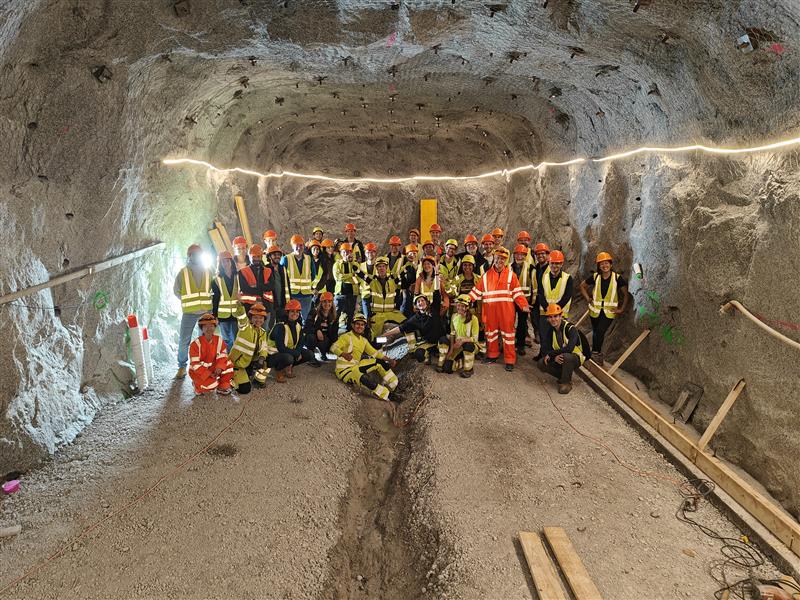
The annual meeting of the FEAR project took place from 13 to 15 May 2025 in Airolo and team members from Rome, Aachen and partners from Berkeley met. Participants reviewed the findings from several experiments already conducted, which provided a substantial basis for discussion. A key focus of the meeting was the upcoming completion of the new side tunnel and the associated experimental testbed where the FEAR main experiments will take place in approximately 6 months. As this marks a critical phase of the project, planning and coordination efforts were intensified.