
Upcoming FEAR-2 Experiment at the BedrettoLab
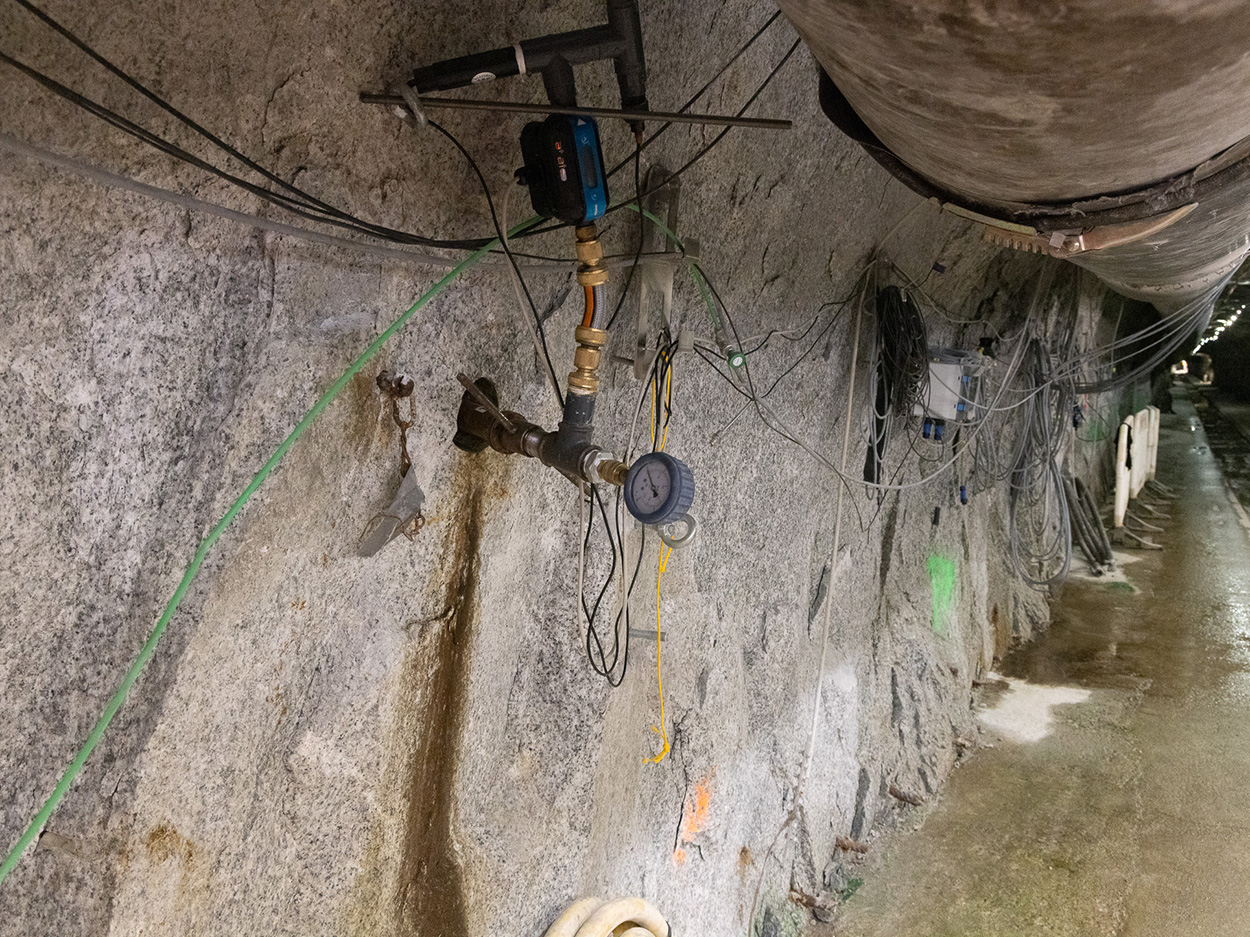
The BedrettoLab is preparing the next step in the Fault Activation and Earthquake Rupture (FEAR) project: the FEAR-2 experiment. In this experiment, scientists will inject water into a densely instrumented natural fault zone to trigger a small, controlled earthquake of about magnitude 1. An earthquake of this magnitude cannot be felt at the surface, but it is large enough to help researchers understand how earthquakes start and how faults behave.
To carry out this work, the team has built a new 120 metre long tunnel starting 2.2 km from the entrance of the main Bedretto tunnel, providing direct access to the fault. A dense monitoring network consisting of several types of sensors placed on and around the fault, in over 40 boreholes, will measure rock deformation, fluid pressure, temperature, seismic activity, and biochemical changes. These observations will help scientists study the entire sequence of processes leading up to and following an earthquake.
The FEAR-2 experiment has been preceded by hydromechanical tests to understand how fluid injection affects the fault’s pressure conditions, deformation, and stability, and how these coupled processes may influence seismic activity.
The subsequent main experiment, hydraulic stimulation, will consist of water being injected over a period of several days to weeks. This process will operate around the clock and be monitored in real time. The team will start by injecting at low pressure, gradually increasing it until the target magnitude of 1 is reached or until 2000 m³ of water has been injected. Numerous much smaller earthquakes are expected to occur before the target magnitude is achieved.
The experiment has undergone a detailed safety and risk assessment, and several layers of safety measures are in place. All high-pressure injection activities are controlled remotely from Zurich, which means that no personnel are present in the tunnel during the stimulations.
According to the safety and risk assessment, the targeted magnitude 1.0 event would likely cause no damage, although very minor damage to the Bedretto and FEAR tunnels, located 30 to 50 meters from the rupture plane, is possible. Severe damage to the tunnels would only be expected in the case of a significantly larger event, with a magnitude of 2.5 or greater. The probability of such an event is estimated at around 1 percent.
We do not expect earthquakes related to the FEAR-2 experiment to be felt or to cause any damage at the surface, in the Furka Base tunnel (2 to 2.5 kilometres away), or in nearby buildings. The probability of an earthquake causing damage outside the Bedretto tunnel is about 0.01 percent (1 in 10,000) and is therefore extremely low. It is much lower than the probability that a natural earthquake occurring over the same period would be felt or cause damage in the area.
Overall, the analysis shows that the FEAR-2 experiments can be carried out safely, with a very low and acceptable level of seismic risk for the Bedretto tunnel, the Furka Base Tunnel, and nearby buildings. The experiment will be closely monitored at all times and will follow strict safety procedures. If any safety threshold is exceeded, injection will be stopped immediately.